Sensing and Control
Sensing and control are the two facets underpinning most IoT applications.
Sensing is the gathering, processing and presentation of data - be it device states, analog or digital measurements, collated or derived data. The information is presented to a network in a way that facilitates integration and usage. This is an exciting time: new ways to generate and consume data at the same time as rapid miniaturisation of computers and sensors.
Control or actuation is the direction by a governing system to act, in some way, on a process. It can be as simple as turning on or off a device, starting a computation, or all manner of movement or action that can remotely controlled. Given the ever widening array of tasks that are computer-controlled, the actions we are now able control is continuously growing.
Computerised control and the Internet of Things are rightly considered the next technological wave - facilitated by the spread of high-speed internet. Microprocessors are also getting cheaper and more energy efficient, which allows them to be economically added into many edge devices. Similarly, as sensors are placed into more and more devices, the data they generate becomes more resolved - and more useful. The data are now available to make better decisions based on better information.
Artificial Intelligence meets IoT
The Artificial Intelligence of Things (AIoT) is the combination of Artificial intelligence (AI) technologies with the Internet of things (IoT) infrastructure to achieve more efficient IoT operations, improve human-machine interactions and enhance data management and analysis.
In AIoT a key facet is processing being done, as far as possible, as close to the data source as possible. This is to limit the requirement to transmit superfluous information. In its purest form this involves performing the AI/machine learning at the device (a.k.a. Edge Computing) with no need for external connections. This obviously requires the latest generation of microprocessors that have the capability and memory to perform meaningful calculations using incoming data.
The combined power of AI and IoT, promises to unlock unrealized customer value in a broad swath of industry verticals. Commonly, these applications rely on data-driven decision making such as edge analytics, autonomous vehicles, remote healthcare, precision agriculture, smart retail, predictive maintenance, and industrial automation.
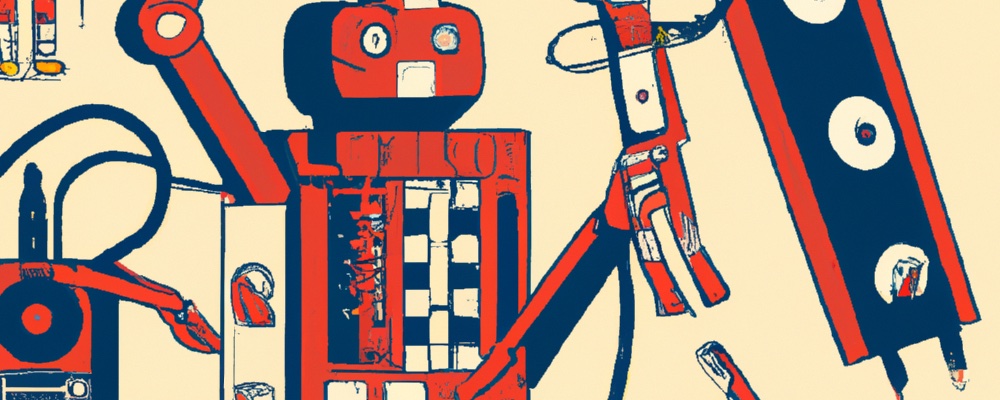
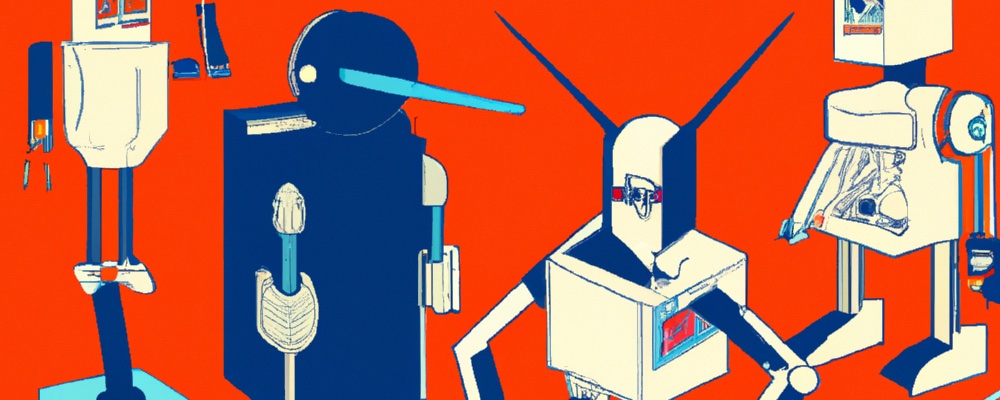

Images generated by AI/Dalle using prompt "Robots making robots"
What can PIATRA do for you?
We are experts at writing drivers for the current generation of microprocessors. We can help you place low-power, long range and efficient sensors into your current processes or machinery. This enables fault sensing, programmed maintenance, data collection, condition monitoring and many other sensor applications.
We have extensive experience in control of electronic and mechanical systems. We can integrate with your old-school or legacy PLC or relay-controlled architectures. We can design and build new automation and control systems, either using custom circuit-board or existing microcomputer options. We can integrate with the entire range of industrial motors - from small scale servo motors to industrial pneumatic actuators.
We can implement the data backbone and cloud-based infrastructure to serve as the nervous system for your control and sensing solutions. If you are starting from scratch we can build or assemble the APIs, databackbones, MQTT networks required to meet or exceed your goals.
- Develop custom sensor solutions
- Integrate sensing into your existing processes
- Control existing mechanical systems
- Design and build new control hardware
- Cloud- or server-based data backbones
You Should Know
All types of common sensors can be easily integrated into your process. If the information is useful it can be integrated one way or another.
The most common sensors used are:
- temperature and humidity
- gas monitoring - CO, H2, etc
- proximity sensors
- physical interlocks
- buttons/binary switches
- sliders/analog switches
- light and sound monitoring
- wind speed and direction
- vibration sensing
- water levels. pH, flowrates
- Web-based data
- API served data
Whatever you application needs, if you have a device that has a control interface, we can use it. If it has no control interface we can automate a robot finger to press a button. There is no limit.
- GPIO/TTL logic signals
- Relay control of Power circuits
- Analog control via I2C or SPI interfaces
- RS232 or RS485 long-range serial bus
- IR remote control signals
- RF remote control signals
- LoRaWan
MQTT stands for Message Queue Telemetry Transport.
It is a lightweight and efficient publish/subscribe messaging transport protocol. In the last few years it has emerged to be the dominant such protocol for implementing the flow of sensing and control signals.
There are many open-source and paid options. It is able to be secured using TLS encryption. It offers an easy way to collect data from various sources into a central hub. Client programs can digest the data from a MQTT broker, to generate user interfaces of logging.
There are several emerging protocols for standardising the reporting endpoints so that devices, sensors and consuming agents can seamlessly interact with any device reporting to the broker that conforms to the standard.