OpenBCI Brain-Computer Interface
Project Overview
This project implements a simple yet powerful brain-computer interface. System learns to correlate clusters of EEG signal activations. This behaviour is mapped onto a small set of learned control directives.

Implementation
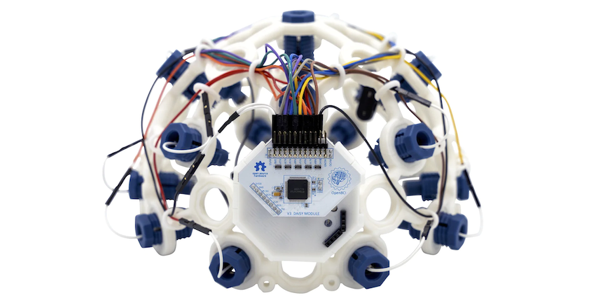
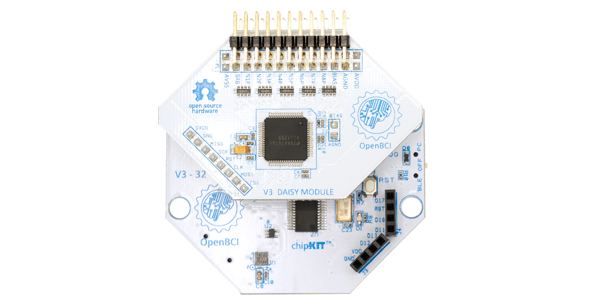
Utilises OpenBCI Cyton biosensing amplifier.
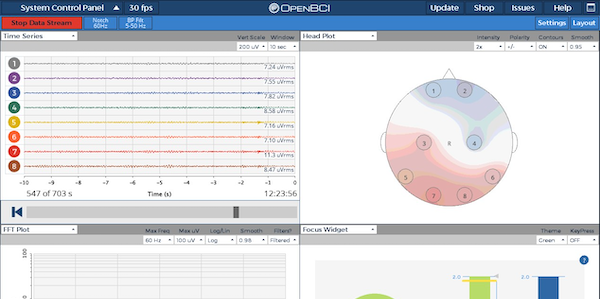
The measured EEG micro-voltage potentials are continuously monitored. Signals for all channels are processed in real time. The rather noisy voltage trace is smoothed and searched to look for a local spike drop in potential. These drops are called activations and correlate with neural activity in the area around the sensor.
We attempt to learn correlations between neural activity and deliberate and conscious thinking. Correlations between neural activity and brain states are inferred after analysing the incoming data streams. The noisy voltage is being scanned for small intermittent spike drops in potential. These drops are considered to correspond to a neural activation.
Incoming data is filtered to identify activations at all EEG sensor locations. The frequency and location of activations in EEG signals is mapped for various preselected thought triggers. A real time analysis of the EEG signals should be able to differentiate between several mapped and distinct triggers. Neural activations when "thinking" of the trigger are compared to a baseline. This allows the interface to function as a series of digital toggles that can be used as normal in control systems.
Thought triggers explored are extreme emotional states, visualising movement in particular directions, remembering smells, etc. The triggers should be explicit, easy and generate clear EEG signals of unique character. The goal is to identify from EEG traces alone which trigger is being projected by the subject.
Notes
- 16-channel Cyton+Daisy biosensing amplifier
- 15 EEG signals measured over scalp
- realtime micro-voltage measurements
- BrainFlow API available in C++ and Python
- data collected and displayed in real-time by Python interface